Volte





This Eco-Cleaning Pioneer Disrupts Chemical Manufacturing Through Circular Packaging and Carbon Accountability
Twenty years ago, while traveling in Italy on a family holiday, UK-based banker Mark Jankovich witnessed a local shop owner pour a bucket of soap suds into the street, watching it drain directly through cobblestones into a harbor where he had just dined on local fish with his family.
That single moment of witnessing the invisible, harsh reality of conventional cleaning chemicals inspired Jankovich to give up finance and launch Delphis Eco to radically change the cleaning industry from the bottom up.
Today, as a proud signatory of The Climate Pledge and a supplier to the UK Royal Household, among many other commercial customers, Delphis Eco proves that professional-grade ecological cleaning products can achieve net-zero operations, pioneer recycled packaging, and help major B2B clients meet their strict Scope 3 carbon targets.
We spoke to Jankovich about the company’s 20-year sustainability journey, its ambitions for net-zero by 2030 and why transforming an entire industry starts with challenging the status quo.
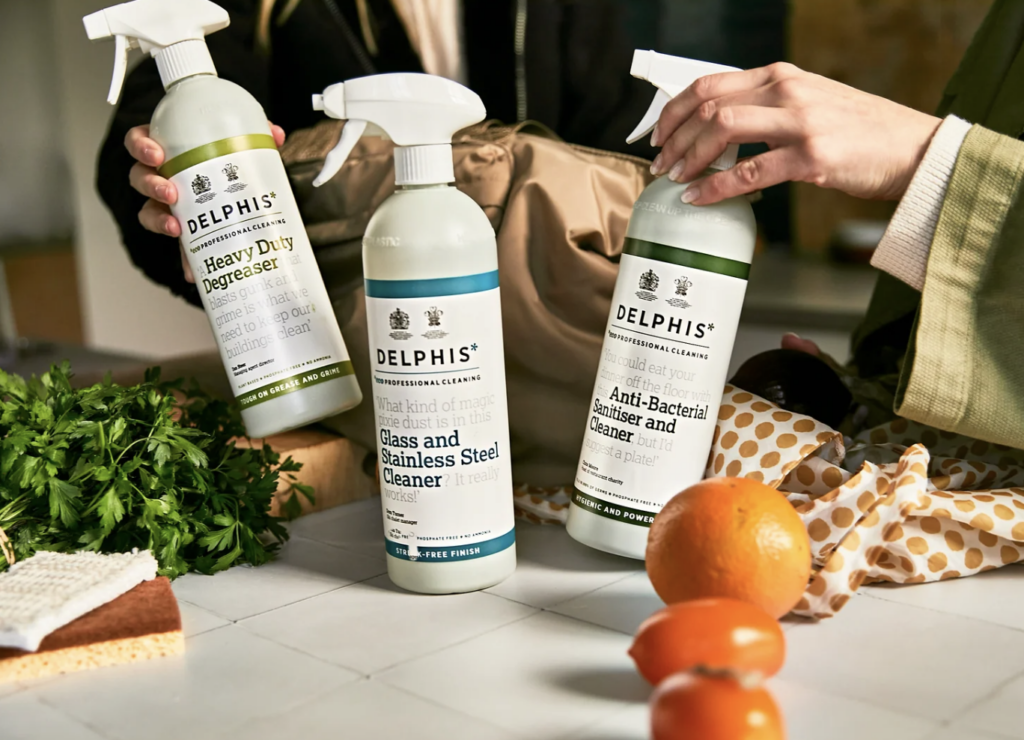
Delphis Eco’s sustainable kitchen cleaning products
When, why, and how was Delphis Eco founded?
After that fateful trip with my family, I Googled how toxic cleaning products really are, and I realized I needed to do something completely different with my life. I knew nothing about the space, but I gave up banking and asked myself: Can I make cleaning products more sustainable? The sole purpose was to disrupt the industry and create genuine environmental impact.
When did reducing carbon emissions become part of your wider sustainability commitment, and why?
When we started 20 years ago, carbon wasn’t the mainstream corporate metric it is today – Greta Thunberg was only four years old! Back then, our focus wasn’t on carbon emissions, but rather on consumer choice and sustainability across the entire product lifecycle. We wanted to rebuild the industry from the ground up, starting with the raw ingredients in our formulations and extending throughout our supply chain.
By using renewable energy and recycled materials, we were already reducing our carbon footprint. Our journey unfolded in three distinct chapters: first, rethinking our chemical formulations; second, transforming our packaging; and third, introducing rigorous carbon accounting. Today, carbon is front and center of our strategy because our B2B clients now have strict carbon reduction targets and rely on our data to help meet them.
What climate action have you taken across your formulations and supply chain?
We’ve taken action across multiple fronts. Historically, cleaning products relied heavily on nasty petrochemicals, which carry long-lasting carbon footprints and can have extended environmental impacts. We replaced them with renewable, plant-based materials like sugarcane and sugarbeets that photosynthesize rather than emit tons of carbon.
Packaging has been another major area of innovation. We were among the first companies in the UK to use 100% single-use recycled plastic. After six years of challenging the incumbent recycling industry, demanding that the UK collect and process plastic, 100% of our bottles are now made entirely of UK-collected and processed Post-Consumer Recycled (PCR) plastic, which slashes carbon impact by about 77% compared to virgin plastic. We also use local recycled cardboard and have optimized our trigger sprays to 47% PCR. Operationally, although we outsource our product blending, we require all our manufacturing partners to switch to 100% renewable energy.
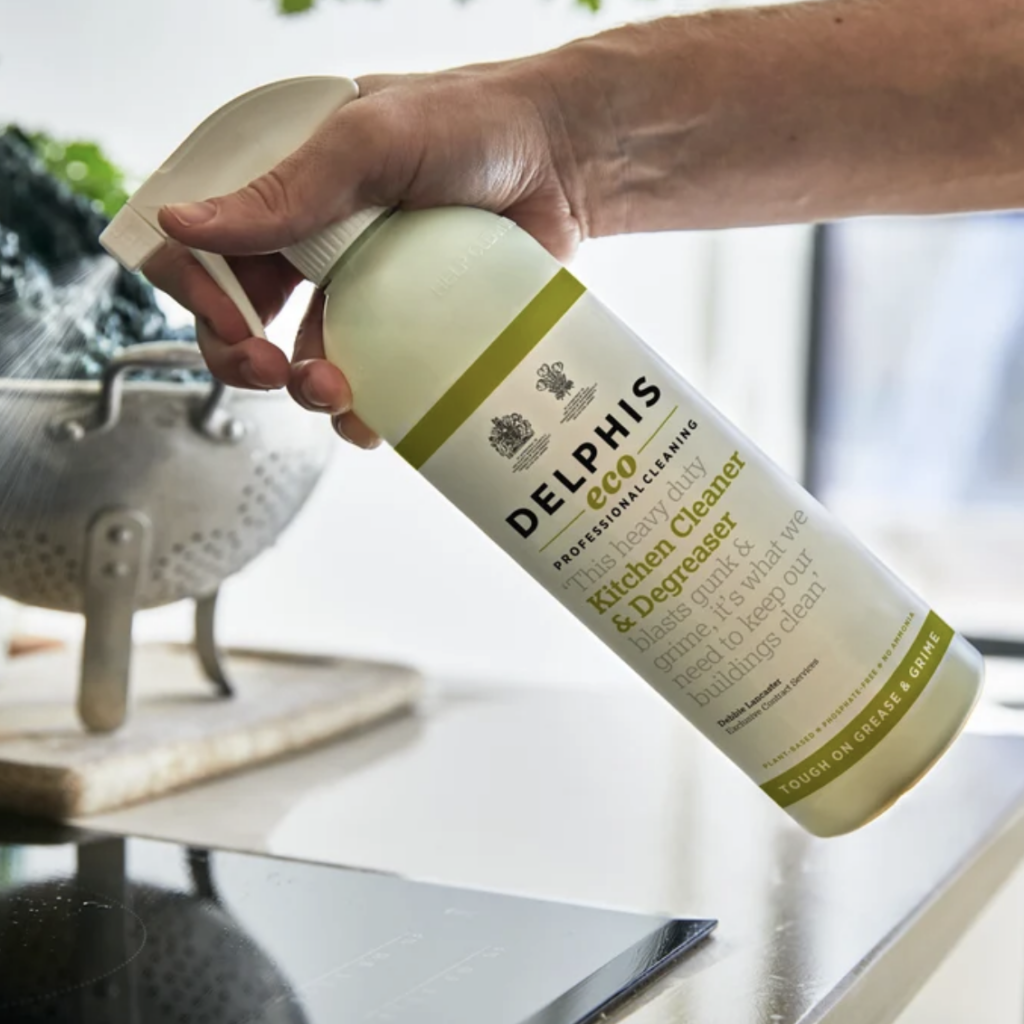
Delphis Eco has optimized the trigger sprays in its products to 47% Post-Consumer Recycled (PCR) plastic
What is the greatest challenge you face in reducing emissions?
Scope 1 and Scope 2 emissions are relatively straightforward—if they were mandated by the UK government tomorrow, managing them would be easy, and ours are already as low as they can possibly be.
Scope 3 is the ultimate challenge in our industry, since so much of our footprint sits outside our direct operations. The two biggest contributors are chemical raw materials we purchase and the transportation of our products. Decarbonizing chemistry requires bold innovation—such as our upcoming goal to use precision fermentation on food waste (like turning brewer’s yeast into useful acids) instead of sending organic matter to landfills, which we project will drop our blending Scope 3 emissions by 96%.
How has signing to The Climate Pledge (TCP) helped accelerate your decarbonization journey?
The Climate Pledge is a fantastic, public commitment. Being part of something backed by Amazon and Global Optimism feels wonderful.
Twenty years ago, I was often seen as the “crazy guy in the corner.” Today, being part of TCP has connected us with a vibrant community of ambitious, like-minded companies. Attending events like New York Climate Week and seeing TCP partner with initiatives like the Earthshot Prize demonstrate just how much the climate conversation has evolved; we are now a little older than the new cool kids and disruptors, but it is great to be with a collective group of game changers, and we are 100% going to hit our targets.
You made the SME Climate Commitment to reach net-zero by 2030. How has making that public commitment mobilized progress?
Setting our Scope 1 and Scope 2 emissions to rock-bottom was our first step. As an environmental leader, going to my manufacturing partners and saying, “We can’t get to net-zero until you get there” has resonated deeply. Every single supplier has responded positively, eager to join us on the journey.
To achieve net-zero by 2030, we have to remain intensely disruptive. On the transport side, we are leveraging TCP’s incredible work in green logistics to slash emissions by 80% over the next three years. On the formulation side, we are collaborating with restaurants and hotels to turn their food waste directly into fresh washing liquid—creating a closed-loop system where waste is given a second life.
How does climate action benefit your business commercially?
We make great cleaning products, period. I challenge every business to be exceptionally good at what they do first—the environmental benefit comes right alongside it. Our corporate customers are long-term thinkers who genuinely care about climate change, but they wouldn’t buy from us if our products weren’t great.
We sell premium cleaning products at competitive prices, and our decarbonization record is a powerful differentiator. Today, when businesses face strict Scope 1, 2, and 3 targets, generic “eco-friendly” claims no longer suffice—they need quantifiable proof that our formulas generate fewer emissions than the industry average, and we can deliver that.
You ask suppliers to take climate action before working with you. How does that work in practice?
In the early days, very few businesses understood carbon emission scopes, so I wrote a supply chain charter and a carbon guide explaining Scopes 1, 2, and 3 to educate our partners. Today, we have a clear expectation: no supplier can work with us unless they explicitly agree to help us reach our 2030 net-zero target.
And they love it. Every business owner has experienced the growing impacts of climate change over the past five years. When a customer asks their supplier to adopt better environmental practices, most are willing to help—they just don’t know how. As an SME, we can play an important leadership role. We visit supplier sites and share our story. Sometimes it’s about making the opportunity tangible—for example, telling a box supplier that their packaging might end up in Buckingham Palace supplying the Royal Household, who are incredibly eco-conscious—turns a routine transaction into a shared mission.
What advice would you give other small businesses looking to advance their climate journeys?
Don’t cut corners and be brave! There isn’t a business owner alive who hasn’t personally experienced the effects of a warming planet. As a corporate buyer, go to your potential suppliers and ask them to manufacture your goods the way you want them made, because they want a stable climate just as much as you do.
Twenty years ago, this work was an uphill battle; today, it is much easier because everyone wants to do the right thing. If all of us ask for better practices and use our collective purchasing power, we will get the results we need.
SMEs make up nearly 50% of The Climate Pledge community. The Climate Pledge supports SMEs like Delphis Eco through its SME Cohort, which provides structured, expert-supported programs to help SMEs build their decarbonization foundation and take meaningful action.