Go back






The Business of Better Sanitation
What if solving one of the world’s most basic needs could also build a successful business?
For Sanjay and Namita Banka, that question has shaped more than a decade of work in water sanitation and hygiene.
When they founded Banka BioLoo in 2012, they set out to make sanitation more sustainable, affordable and accessible. What started with bio-toilets has grown into a business spanning sanitation, hygiene, wastewater treatment and water management, serving communities, institutions, and some of India’s largest organizations.
The business has grown dramatically along the way, from ₹70 lakh (US$70,000) in revenue in its first year (2012) to over ₹70 crores (US$7 million) in 2026. Its solutions have reached more than 2,000 schools, helped recycle more than 5 billion litres of water, and provided livelihoods to more than 1,500 young people from low-income families.
But perhaps the most interesting part of Banka Bio’s story is not what the company does itself. It is how many other people and businesses its work reaches.
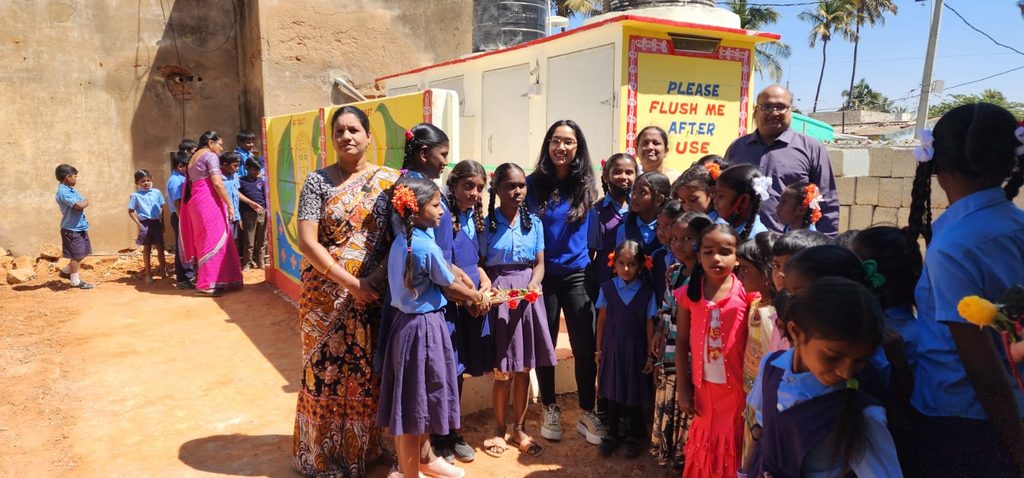
BioLoos installed in rural schools by BankaBio
Turning purpose into a business that can scale
The first major breakthrough came from Indian Railways.
In 2012, the company set up a manufacturing unit to produce bio-tanks for railway coaches. A year later, it secured its first railway service contract. As Indian Railways embarked on a major drive to improve sanitation across its network, Banka Bio grew alongside it installing, servicing, and maintaining bio-toilets across the network.
For a young SME, the railway network became a powerful proving ground. It showed that a relatively small business could take an environmental solution, and make it work across a vast and complex infrastructure system.
But for Namita, sanitation was never simply an infrastructure problem. As a woman entrepreneur working in the sector, she had seen how deeply the absence of safe sanitation could affect women’s security and dignity.
“It matters to women across the world. It matters to me. It’s about the dignity that every woman deserves.”
– Namita Banka, Managing Director, Banka Bio
That perspective has remained part of the company’s story as it has grown, from railway coaches to schools, workplaces and communities. It also opened the door to a much wider market.
The SME has since taken that experience into a much wider market, working with some of India’s biggest corporates and public sector organizations, including GAIL, Havells, Indian Space Research Organisation, Shapoorji Pallonji, L&T, Godrej, Reliance, My Home Group, among others, as well as government agencies, schools and communities. Its solutions have been used in settings, ranging from factories and construction sites to remote and worker accommodations.
The problem may be universal. The solutions have to be available where people actually live and work.
Building a business around impact
The business is built around helping other organizations manage a fundamental resource more responsibly. A factory can improve its water and sanitation infrastructure. A company can provide better facilities for its workforce. A large organization can extend water, sanitation, and hygiene (WASH) practices into its supply chain. A school can provide children with safer sanitation.
Sanitation is a vital sustainability issue because untreated waste poisons local water supplies and hampers community development. Through its work with corporate partners, including through the WASH4Work initiative, Banka Bio has helped bring water, sanitation and hygiene into conversations about responsible business, rather than treating them solely as sustainability, ESG or CSR issue.
The company has also worked with many businesses through CSR programs to bring sanitation to schools and underserved communities, including a 5-year partnership with Havells.
In other words, the business grows by helping other organizations solve problems that matter to people and the planet.
That is a powerful model for an SME in the climate transition: not simply reducing its own environmental impact but creating products and services that enable others to do better.
Banka Bio has also shown that an impact-led business can be commercially ambitious.
In 2018, it became the first sanitation company to raise ₹12.62 crore (US$2 million) through an SME IPO and list on the NSE’s SME platform, Emerge. Two years later, it received the first tranche of a US$1 million impact investment from WaterEquity.
For Sanjay and Namita, the lesson is straightforward: solving an environmental or social problem does not have to sit outside the business case. It can be the business case.
Showing up early
That belief also explains why Banka Bio was among the first group of Indian SMEs to make the SME Climate Commitment.
For Sanjay, climate leadership is not something reserved for the largest corporations.
“No business, large or small, can afford to be climate complacent. SMEs have an important role to play, and we need to lead on climate action in our own spheres.”
– Sanjay Banka, Executive Chairman, Banka BioLoo Limited
For Banka Bio, joining the SME Climate Hub was a way to make that commitment visible, connect with other climate-conscious businesses, and bring an Indian SME perspective into a wider conversation about business and climate action.
It is a role Sanjay has increasingly taken beyond his own company.
From building solutions to shaping the conversation
Banka Bio’s work first brought Sanjay onto the global stage in 2015, when the company was selected as one of 14 innovators from submissions worldwide to present at the UN Solutions Summit in New York.
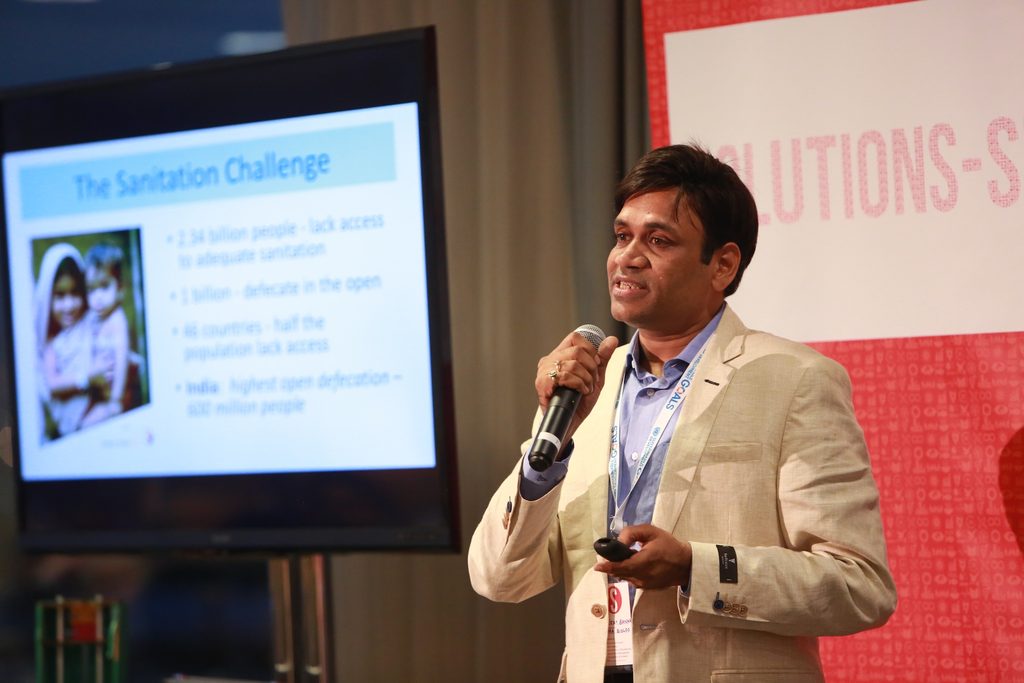
Sanjay Banka presents at the UN Solutions Summit in New York.
Since then, his work has increasingly bridged business, policy and the global water and sanitation community. He became the first private-sector representative to join the Steering Committee of Sanitation and Water for All, a multi-stakeholder partnership; and today serves on the Board of Human Right 2 Water and the Steering Committee of the Global Water Operators’ Partnerships Alliance (GWOPA), among other global positions.
These roles give Sanjay an opportunity to bring a perspective that is sometimes missing from global policy discussions: what it takes to build and deliver solutions in the real world.
For an entrepreneur, it is a remarkable journey, from solving a practical sanitation challenge in India, to helping shape the conversations around water and sustainable development globally.
Looking ahead
Banka Bio’s ambition has grown considerably since those first railway bio-toilets. The company now aims to reach 10 million+ people globally, with sustainable water, sanitation and hygiene solutions.
For the SME Climate Hub community, its journey offers a different way of thinking about climate leadership. It doesn’t always begin with a company trying to become a ‘green business’. Sometimes it begins with an entrepreneur asking how to solve a problem better.
And sometimes, the business built around that solution can help many others become part of the change, too.