
 Go back






How a Furniture Manufacturer Is Turning Carbon Data Into Competitive Advantage
The commercial furniture industry contributes massive amounts of waste to landfills, creating a significant environmental challenge for modern workplaces. However, design-forward manufacturer and The Climate Pledge signatory Hightower is actively rewriting this narrative.
From its roots bridging Scandinavian design with American manufacturing to its current work advancing sustainability in commercial furniture, the company views climate action not as a compliance burden, but as a core strategic driver. Under CEO Natalie Hartkopf and their dedicated sustainability team, Hightower is navigating complex Scope 3 supply chain networks and implementing proactive circular design principles. As a result, Hightower has gained a distinct competitive edge, helping respond to increasingly sophisticated sustainability requirements.
When, why, and how was your business started?
Hightower started in Seattle during the early 2000s as a creative way to connect the dots between the U.S. market and Scandinavian designers. At the time, we recognized that the materiality, craftsmanship, and working styles in Scandinavia were years ahead of what we were seeing domestically. Over time, we evolved. To optimize our lead times, tap into incredible domestic skill sets, and shorten our logistical footprint, we began partnering with local labor in North Carolina around 2010 to manufacture and license our furniture closer to home.
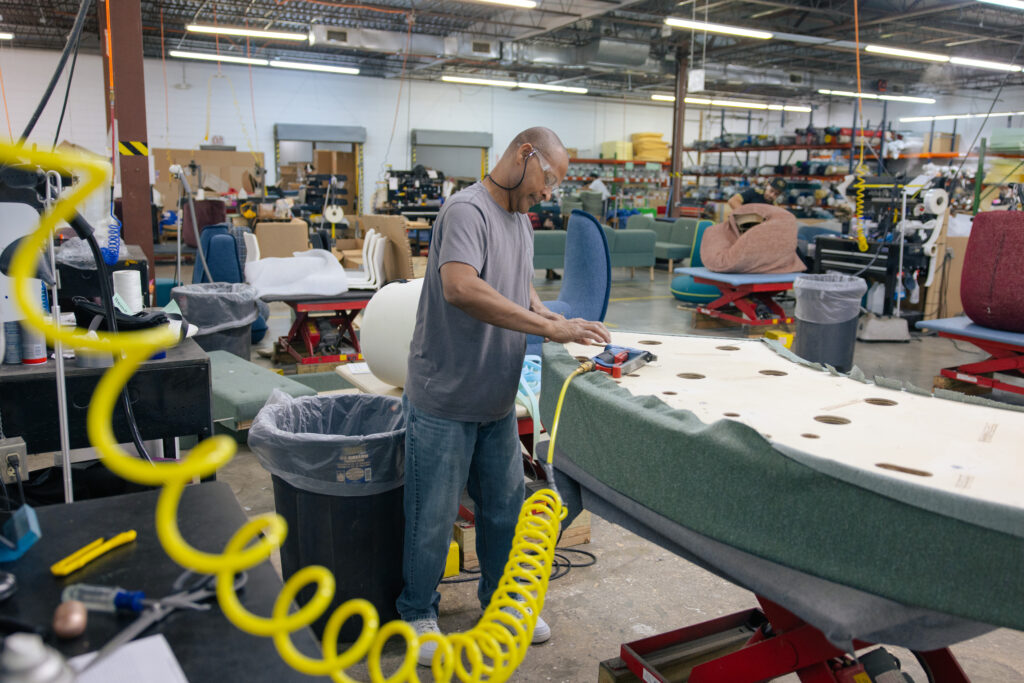
Manufacturing its products in the US instead of overseas allows Hightower to reduce transport emissions from its overall product carbon footprint.
When did climate action first become a priority for your business? Was there a “wakeup call” moment?
When Natalie Hartkopf took over as CEO in 2018, she made it an immediate priority to infuse a clear social purpose into why and how we make furniture. The commercial furniture industry contributes heavily to global waste. An astronomical amount of office furniture goes straight to landfills instead of being reused.
At the time, there was growing industry momentum around material health and transparency. To formalize our journey, we set our sights on achieving B Corp certification. We used the rigorous B Corp Impact Assessment as our strategic roadmap to figure out what a truly positive business looks like, which helped us identify gaps and establish a more structured approach to measuring our impacts. We officially secured our B Corp certification in 2023.
What climate action steps have you taken?
Sourcing and shipping are major focal points for us. A large part of our business involves importing, so reducing the transit distance of our products has been a significant win. We also began examining the materials and components that contribute to our environmental footprint, calculating the ratio of virgin versus recycled components—like metals, wood, and plastics—that enter our portfolio.

Hightower’s Rex Chair is made from 98% recycled Econyl, a polyamide-based material sourced from recycled carpets and fishing nets.
Finding better ways to reduce waste and give second lives to our products has become a major focus. Because of this focus on circularity, we’re proud to have achieved a 71% landfill diversion rate. We continued investment in our managed recycling program to ensure that materials like cardboard, wood, metal, and plastics are properly sorted and recycled.
Rather than just reactively measuring our carbon footprint after a product is made, we’ve shifted to proactive “design for end of life,” heavily inspired by our European partners. We are reducing the use of adhesives where possible, favoring mono-material components to make disassembly and material recovery easier, and revisiting existing collections to explore opportunities to extend their useful life. For example, we launched Kona removable slipcovers to refresh our Kona collection, offering new design possibilities while supporting product longevity. We implemented a Closed Loop Take-Back Program that gives customers a $20 rebate per chair, and we repair, reuse, or responsibly recycle the components to avoid sending the parts to a landfill.
Architecturally, we’ve also completely overhauled our logistics. Between 2024 and 2025, air shipments handled by our inbound logistics partner decreased by 35%, while ocean shipments remained steady. This contributed to a 42.6% reduction in associated transportation emissions and a 37.8% improvement in emissions intensity per metric ton shipped. While these figures represent only a portion of our transportation footprint, they demonstrate how changes in shipping patterns can support measurable emissions reductions.
We launched a major initiative to aggressively reduce air freight, shifting our primary transport method to ocean freight. As a result, we experienced an incredible, unplanned 42% drop in our carbon intensity factor between 2024 and 2025.
What is the greatest challenge you face to reducing emissions?
Without a doubt, it is our complex supply chain and our Scope 3 emissions, which we confirmed this year in our Scope 3 greenhouse gas assessment. The largest share of Hightower’s emissions occurs upstream — primarily through materials, manufacturing, and freight. Because we are not completely vertically integrated and maintain a diverse product portfolio, we source components from a vast network of suppliers. Aggregating all of that fragmented data and turning real-world supplier actions into accurate, verified carbon numbers remains our hardest day-to-day challenge.
How has committing to the SME Climate Hub and The Climate Pledge helped your decarbonization journey?
If you don’t have deeply specialized experience, translating abstract climate goals into different operational parts of a business is incredibly tough. In small teams, it’s common to have just one sustainability manager carrying the torch. While our broader team is wonderfully supportive, they don’t face the exact same technical roadblocks.
Joining The Climate Pledge’s SME Cohort has provided invaluable camaraderie and peer support. We entered the cohort to set highly ambitious, transparent targets (such as halving our emissions by 2030 and hitting net zero by 2050) even before our baseline data was finalized, because it aligns with our values.
Utilizing the SME Climate Hub’s free resources — like the SME Climate Hub’s Small Business Carbon Calculator — ultimately empowered us to build the internal business case to secure the budget for a dedicated, long-term carbon accounting software.
Crucially, because this is an explicit priority driven straight from our CEO, our sustainability initiatives have a top-down mandate and real budget behind them.
Most of your business emissions come from purchased materials like metals, wood, and plastics. How are you striving toward sustainable sourcing?
We deliberately seek out and partner with suppliers who are already putting in the work with renewable, bio-based, or circular materials. It creates a virtuous circle; our fabric and component partners are equally motivated to offer us low-carbon stories, bio-foams, or materials derived from ocean plastic.
Our internal design team now works directly with these parameters from day one, figuring out how components can be easily replaced, separated, and recycled at a product’s end of life. For example, when one of our Italian partners recommended a sustainable slipcover technique, or when a supplier introduced a bio-based foam, we integrated them immediately into upcoming launches.
We’re also investing time in building our sourcing capabilities, with our Purchasing Manager currently participating in The Climate Pledge’s Procurement Training to further strengthen how we embed sustainability into procurement.
How does climate action benefit your business commercially?
We are seeing a notable shift in market demands. Historically, tracking carbon emissions was heavily focused on the construction phase of architecture. Now, more stringent standards have trickled down directly to ancillary products and interior finishes. Because we proactively undertook carbon accounting, material transparency, and environmental certifications, before it was legally or commercially mandated, we are in a prime competitive position looking forward. We can more easily answer rigorous procurement questions from clients and remain competitive on projects with ambitious environmental requirements .
Additionally, these environmental constraints have unlocked internal innovation. Encouraging our designers to reduce waste or improve material efficiency, and consider circularity has actually challenged them to be much more creative with the resources we already possess.
You have released a sustainability report annually since 2023. What have you learned from that process?
The feedback from stakeholders and customers has been remarkably positive because the report translates dense climate data into digestible, concrete activities. Internally, the process made us far more intentional. As an agile business, we do so many great things across our manufacturing plants that we don’t always take the time to write down. Compiling the report acted as a vital touchpoint for internal planning, helping us establish highly specific, forward-looking goals to measure ourselves against every single year.
Do you have any advice for other small businesses starting out on their climate journeys?
Be completely transparent and vulnerable about what you do not know or where your business is struggling. If you are having trouble finding a sustainable component or hitting a wall with supplier data, just put it out there into collaborative forums. The vast majority of people on this collective decarbonization journey genuinely want to help others succeed. Whenever you enter rooms like the Climate Pledge Salons, you quickly realize you aren’t the only one facing these complex bottlenecks. Lean into the camaraderie, join the conversations, and don’t be afraid to speak up.
SMEs make up nearly 50% of The Climate Pledge community. The Climate Pledge supports SMEs like Hightower through its SME Cohort, which provides structured, expert-supported programs to help SMEs build their decarbonization foundation and take meaningful action.


